The International Golf Property Buying Timeline
International golf property purchases typically move through a longer and more structured timeline than a domestic transaction, particularly when foreign ownership approvals, cross-border financing, or currency conversion are involved. While exact timelines vary by country, a realistic international golf property purchase generally follows a pattern similar to this:
Stage 1 — Research and shortlisting (4–12 weeks). This stage involves narrowing down target countries, cities, and communities based on purpose, budget, and lifestyle priorities, and typically includes remote research, virtual tours, and initial conversations with local agents or platforms such as RealEstateLands.
Stage 2 — Site visits and due diligence (2–8 weeks). Serious buyers generally visit shortlisted properties and communities in person where possible, meet with local legal and tax professionals, and begin verifying ownership eligibility, golf access terms, and community fee structures in writing.
Stage 3 — Offer, negotiation, and contract (2–6 weeks). Once a property is selected, this stage covers making an offer, negotiating terms, and signing a purchase agreement, typically with the involvement of independent local legal counsel and, where relevant, a foreign-buyer approval process such as FIRB in Australia.
Stage 4 — Financing and approvals (4–12 weeks, if applicable). For buyers using financing, this stage covers mortgage approval, currency arrangements, and any required foreign-buyer authorizations, which can extend the timeline considerably compared with a cash purchase.
Stage 5 — Closing and transfer (2–6 weeks). The final stage covers title transfer, settlement of funds, registration of ownership, and, where applicable, activation of any golf club membership associated with the property.
Stage 6 — Post-purchase setup. After closing, buyers typically need to arrange local property management (for second homes or investment property), insurance, utility transfers, and, where relevant, enrollment in club membership programs.
Altogether, a realistic international golf property purchase — from initial research to closing — often takes anywhere from three to nine months, and buyers should build this timeline into any relocation, retirement, or investment planning rather than assuming the process will move as quickly as a domestic purchase.
Insurance Considerations for Golf Property
Insurance requirements for golf real estate can differ from standard residential coverage, particularly for properties directly bordering a course or located in regions with specific environmental exposure.
Course-adjacent liability. Homes bordering an active fairway occasionally face liability questions related to stray golf balls, and some insurers offer specific endorsements addressing this exposure. Buyers should ask directly whether standard homeowners' coverage in the destination country addresses this scenario.
Climate and environmental exposure. Many golf destinations are located in regions with specific climate risks — coastal storm exposure in Florida and parts of Australia, wildfire risk in parts of California, or flood exposure in some UK and European locations. International buyers should confirm what is and is not covered under local insurance products, since coverage standards and availability vary significantly by country.
Vacant-property coverage. Second-home and investment buyers whose golf property will sit vacant for extended periods should ask specifically about vacant-property insurance terms, since standard policies in many countries include occupancy requirements that can affect claims if the home is unoccupied beyond a certain threshold.
Community and club insurance. Buyers should also understand what is covered under the community's or club's own insurance — for shared facilities such as clubhouses, pools, and course infrastructure — versus what remains the individual homeowner's responsibility.
Working with a Golf Real Estate Specialist
Because golf real estate involves layered governance, specialized fee structures, and, for international buyers, cross-border legal and tax considerations, working with an agent or platform experienced specifically in golf and international property can materially reduce risk compared with working through a generalist.
A specialist should be able to clearly explain the distinction between HOA fees and club fees for any given property, provide a written breakdown of what golf access does and does not include, connect buyers with independent local legal and tax professionals rather than only in-house or developer-affiliated representation, and offer realistic guidance on rental potential and seasonality specific to the destination market rather than generic assurances.
International buyers should treat the quality of this guidance as part of their overall risk management, not simply a convenience, since the complexity of cross-border golf property transactions makes experienced, independent guidance significantly more valuable than in a standard domestic purchase.
Sustainability and the Changing Face of Golf Development
Golf real estate development has evolved considerably in recent years, with many newer communities placing greater emphasis on water efficiency, native landscaping, and broader environmental management than older, more traditional developments.
This shift matters for buyers for several practical reasons beyond environmental preference alone. Communities with modern, efficient irrigation and landscaping systems often carry lower long-term maintenance costs, which can directly affect community fees. In regions facing water scarcity concerns, a course's long-term water management approach can also influence its long-term viability and, by extension, the long-term value of surrounding property.
Buyers evaluating newer golf developments should ask directly about water sourcing, irrigation technology, and any sustainability certifications the course or community holds, particularly in drier climates such as parts of the southwestern United States, the UAE, and southern Australia, where water management has become an increasingly important factor in course longevity.
Golf Real Estate Glossary for International Buyers
International buyers researching golf property across multiple countries often encounter terminology that varies in meaning between markets. This glossary summarizes commonly used terms.
Fairway-front / fairway-facing — A property positioned directly alongside the playable fairway of a golf hole, typically commanding a premium over similar homes without direct course frontage.
Country club community — A residential development where the golf course and clubhouse function as a private club, generally requiring membership for full access, common in the United States.
Semi-private course — A golf course that is primarily membership-based but also allows a limited number of public bookings, a common structure in the UK and parts of Europe.
Equity membership — A membership structure, common in some US and UK clubs, in which members hold a financial stake in the club itself, sometimes refundable or transferable upon resignation.
Social membership — A membership category providing access to clubhouse and social facilities without full golf playing privileges.
Bond or debenture — A financial instrument used by some golf clubs, particularly in the UK and parts of Asia, requiring members to pay an upfront sum that may or may not be refundable, separate from ongoing dues.
HOA (Homeowners' Association) — A governing body responsible for community-wide rules, common-area maintenance, and associated fees, distinct from golf club membership.
Freehold — Outright ownership of both the property and the land it sits on, the most common ownership structure in the US, UK, Canada, and Australia.
Leasehold — A form of ownership in which the buyer holds rights to the property for a defined period, common in some international markets, particularly parts of the Middle East and Asia, and requiring careful review of lease terms and renewal conditions.
FIRB approval — Approval required from Australia's Foreign Investment Review Board for most foreign purchases of Australian residential property.
Exit Strategy: Reselling International Golf Property
Even buyers focused primarily on lifestyle rather than investment should think through resale considerations before purchasing, since golf property in a weak or declining club can be significantly harder to sell than comparable non-golf property in the same general area.
Course financial health is one of the strongest predictors of long-term resale demand. A course with declining membership, deferred maintenance, or an uncertain ownership structure can drag down surrounding property values regardless of how well an individual home has been maintained.
Community trajectory matters as well. Buyers should distinguish between an established, fully built-out community with a stable resident base and a newer development still under construction, since the latter carries additional uncertainty about how the finished community will ultimately look and perform.
Buyer pool considerations are particularly relevant for international sellers. Some golf properties appeal primarily to a narrow buyer profile — retirees, for example — which can lengthen the time needed to find a buyer compared with more broadly appealing residential property.
Currency timing, for cross-border owners, can materially affect real resale proceeds once converted back to the seller's home currency, and should be factored into any long-term exit planning alongside the property market itself.
The Future of Global Golf Real Estate
Golf real estate is likely to remain a durable international property category rather than a passing trend, supported by an aging global population with strong retirement demand, continued growth in international remote work and lifestyle relocation, and the ongoing maturity of golf tourism in established and emerging destinations alike.
At the same time, the market is likely to keep diversifying. Newer golf developments increasingly combine golf with broader wellness, hospitality, and multi-generational lifestyle amenities, reflecting buyer demand that extends well beyond golf itself. International buyers who understand this broader context — rather than evaluating golf property purely on course quality — will generally be better positioned to make decisions that hold up over the long term.
Golf Real Estate and the Remote Work Effect
The growth of remote and flexible work arrangements over the past several years has quietly reshaped demand in international golf real estate. Buyers who once needed to remain close to a specific office location are now able to consider golf communities in an entirely different country, provided reliable internet connectivity, reasonable time-zone overlap with colleagues, and access to an international airport are available.
This shift has had a noticeable effect on demand in destinations such as Florida, Arizona, Portugal, Spain, and parts of the UAE, where a combination of favorable climate, established international communities, and improving digital infrastructure has made year-round or seasonal remote living increasingly practical for golf-lifestyle buyers who are not yet retired.
Buyers considering this path should evaluate internet reliability, home-office space within the property itself, and local visa or residency options tied to remote work or investment, since these factors are now as relevant to many golf property buyers as the course itself.
Twenty Questions to Ask Before Buying International Golf Real Estate
A focused set of direct questions, asked before making an offer, can surface most of the issues that commonly derail international golf property purchases.
- Is golf club membership included, optional, or entirely separate from ownership?
- What are the current annual HOA fees, and how frequently have they increased historically?
- What are the current golf club dues, and are they separate from HOA fees?
- Is there an initiation fee or bond required for club membership, and is it refundable?
- Who owns and operates the golf course, and is that ownership stable?
- Has the course undergone any recent changes in management, ownership, or maintenance standards?
- What percentage of the community is currently built out versus still under development?
- Are there restrictions on short-term or seasonal rental within the community?
- What insurance coverage is required, and what specific risks does it include or exclude?
- Is the property eligible for purchase by a foreign buyer under current local law?
- What government approvals, if any, are required before the purchase can proceed?
- What are the full closing costs, including legal fees, transfer taxes, and any foreign-buyer surcharges?
- How is the property's water supply managed, and is the region subject to any water restrictions?
- What is the realistic golf season length at this specific location?
- How far is the property from the nearest major international airport?
- What healthcare facilities are available within a reasonable distance?
- Is independent legal representation required, and has it been arranged separately from the seller's team?
- What has historical resale demand looked like for comparable properties in this specific community?
- Are there any known future development plans nearby that could affect views, traffic, or property value?
- What ongoing property management options exist locally if the property will not be occupied year-round?
Working systematically through this list before making an offer gives international buyers a far more complete picture than relying on marketing materials or a single site visit alone.
Start Your International Golf Property Search with RealEstateLands
RealEstateLands.com is built as a starting point for exactly this kind of cross-border property research — buyers comparing golf communities, cities, and countries rather than searching within a single local market.
Whether the goal is a golf villa in a resort destination, a family home inside a golf-oriented community, a retirement residence with year-round course access, a second home for seasonal travel, or an investment property in an established international golf market, the right decision depends on evaluating the property, the community, the golf course, the location, the total ownership cost, and the local legal and ownership requirements together — not in isolation.
Ready to explore golf real estate opportunities across the USA, UK, Canada, Australia, and beyond? Browse current golf and lifestyle property listings on RealEstateLands, or contact our team directly to discuss international golf property options that match your goals, budget, and timeline. You can also reach our team directly via WhatsApp for property inquiries, or call our hotline at +880 19105-03795, or email info@realestatelands.com.
Key Takeaways Before You Begin Your Search
Before starting an active international golf property search, it is worth summarizing the core principles covered throughout this guide, since these apply consistently regardless of which country or community a buyer ultimately chooses.
- Define your purpose first — permanent residence, retirement, second home, or investment — since this shapes every other decision that follows.
- Never assume golf access is automatically included with property ownership; always confirm membership terms in writing.
- Separate HOA fees from golf club fees and request a full, written breakdown of both before making an offer.
- Verify foreign ownership eligibility for your specific target country early, since rules in markets like Canada and Australia can directly affect whether a purchase is even possible.
- Evaluate the community and the course's financial health, not just the individual home, since both directly affect long-term value and livability.
- Always retain independent local legal representation, separate from the seller's or developer's team, in the country of purchase.
- Account for seasonality in both golf access and rental demand, particularly in markets such as the UK and Canada.
- Budget for the full ownership cost — purchase price, fees, taxes, insurance, and maintenance — not the purchase price alone.
- Treat resale potential as part of the initial decision, not an afterthought, by researching the course's stability and the community's buyer pool before purchasing.
Keeping these principles in view throughout the research process helps international buyers move from a broad, emotionally driven search toward a structured, well-informed decision.
Frequently Asked Questions About International Golf Real Estate
Is golf real estate a good investment?
Golf real estate can perform well as an investment in established markets with strong tourism, a reputable course, and consistent rental demand, but proximity to a golf course alone does not guarantee good returns. Investment decisions should be based on complete financial and market analysis, not the golf course alone.
Do I need to be a golfer to buy a golf property?
No. Many buyers purchase golf-community property primarily for the neighborhood design, amenities, and lifestyle rather than golf itself. However, buyers who do not plan to use the course should still confirm whether golf-related fees are mandatory as part of ownership.
Can foreigners buy golf real estate in the United States?
Generally, yes. The United States does not impose federal restrictions on foreign ownership of most residential real estate, including golf property, though buyers should still work through the standard purchase process and confirm any state-specific requirements with a qualified local professional.
Can foreigners buy golf property in Canada?
Foreign buyers may face restrictions on residential property purchases in Canada, and rules can change over time. Anyone considering a Canadian golf property purchase should verify current foreign ownership regulations with a Canadian real estate lawyer before proceeding.
Do I need FIRB approval to buy golf property in Australia?
Most foreign buyers purchasing residential property in Australia, including golf-community homes, are required to obtain approval from the Foreign Investment Review Board. Requirements and fees can change, so this should be confirmed directly and treated as an early step in the process.
Is golf club membership included when I buy a golf property?
Not always. Membership structures vary significantly between developments. Some properties include automatic or discounted membership, while others require a separate application, fee, and ongoing dues. This should always be confirmed in writing before purchase.
What are the biggest additional costs beyond the purchase price?
Common additional costs include homeowners' association or community fees, golf club membership dues, property taxes, insurance, ongoing maintenance, and, for international buyers, currency conversion and cross-border legal costs.
Is golf property a good option for retirement?
Golf communities are a popular retirement choice due to their social environment, recreational amenities, and often low-maintenance housing. Healthcare access, mobility needs, and proximity to essential services should still be evaluated carefully alongside the lifestyle appeal.
How seasonal is golf real estate demand?
Seasonality varies significantly by location. Markets such as Florida, Arizona, the UAE, and much of Australia offer largely year-round golf, while markets such as the UK and Canada see more pronounced seasonal variation in both golf access and rental demand.
Can I rent out my golf property when I'm not using it?
This depends entirely on local rental regulations and the specific community's rules, which can restrict or prohibit short-term rental. This should be confirmed before purchase, particularly for buyers who plan to offset ownership costs through rental income.
What is the difference between a golf villa, a golf estate home, and a golf condominium?
A golf villa is typically a detached or semi-detached home with private outdoor space, often along a fairway. A golf estate home is generally a larger detached house on a bigger lot within a gated community. A golf condominium offers lower-maintenance, often smaller-footprint ownership, typically in a mid-rise or high-rise building.
Should I hire my own lawyer when buying international golf real estate?
Yes. International buyers should always retain independent local legal representation in the country of purchase, separate from the seller's or developer's legal team, before signing any binding agreement.
What is the difference between an HOA fee and a golf club fee?
An HOA fee covers general community costs such as common-area maintenance, security, and shared amenities. A golf club fee is typically separate and covers course maintenance and club operations, and is only charged to members. Many golf properties involve both, billed independently.
How long does it typically take to buy international golf real estate?
A realistic timeline from initial research to closing typically ranges from three to nine months, depending on the country, financing arrangements, and any required foreign-buyer approvals. Cash purchases in open markets tend to move faster than financed purchases involving foreign-buyer approval processes.
Is it better to buy golf real estate in a private, semi-private, or public course community?
This depends on priorities. Private country club communities generally offer the most consistent course quality and exclusivity but at higher ongoing cost. Semi-private and public-adjacent communities can offer lower fees and more flexibility, but potentially less predictable course maintenance and access.
Do golf properties typically appreciate faster than standard residential property?
Not necessarily. Appreciation depends on the same fundamentals as any property — location, market supply and demand, and broader economic conditions — combined with the specific health of the golf course and community. A well-located non-golf property can outperform a golf property in a declining club, and vice versa.
What happens to my golf property investment if the course closes?
Course closures can significantly affect surrounding property values and the community's overall appeal, since the amenity that originally attracted many buyers is no longer available. This is one reason evaluating a course's financial health and ownership stability before purchase is an important part of due diligence, rather than an afterthought.
Final Thoughts
International golf real estate offers a genuinely distinctive way to combine property ownership with lifestyle, recreation, and community, but it also comes with more complexity than a standard domestic purchase. The strongest global markets — the United States, the United Kingdom, Canada, Australia, and established international destinations such as the UAE, Spain, and Portugal — each have their own climate patterns, ownership rules, tax treatment, and community styles, and none of them should be evaluated purely on the strength of the golf course itself.
A disciplined, well-researched approach — starting with a clear purpose, followed by careful comparison of countries, communities, and individual properties, and supported by independent local legal and financial advice — gives international buyers the best chance of finding a golf property that fits their lifestyle today and continues to make sense for years to come.
RealEstateLands.com is here to support that search, with structured guides, listings, and direct access to a team experienced in international property research across golf, lifestyle, and investment-focused markets worldwide.
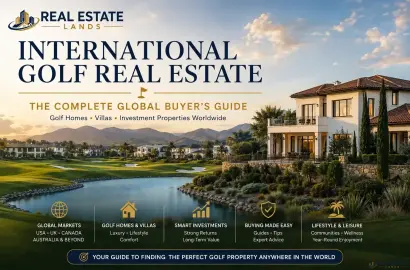

 International Golf Real Estate: The Complete Global Buyer's Guide to Golf Homes, Villas & Investment Properties Worldwide Part 2
 Luxury Real Estate Worldwide | Luxury Homes & Properties
 Golf Real Estate Worldwide | Golf Homes & Properties
 Explore Property Types | Global Real Estate